How to Spot Heatstroke in Dogs Before It Turns Life-Threatening
Heatstroke in dogs moves fast. A dog can go from heavy panting to organ damage in under an hour, and the window where simple help works best is the first ten minutes. Most owners picture a dog locked in a hot car. The research tells a different story: most cases start on an ordinary walk.
At TVS Animal Hospitals, we treat overheated dogs across Downtown Toronto and North York every summer. Here is what heatstroke in dogs looks like at each stage, what to do in those first ten minutes, and how to prevent it altogether.
Why dogs overheat faster than people expect
Dogs barely sweat. They shed almost all excess heat by panting, which cools through evaporation from the tongue and airways. Humid air slows evaporation, so Toronto's sticky summer days quietly switch off a dog's main cooling system. The Humidex matters more than the thermometer.
A dog's normal body temperature sits between roughly 38 and 39°C. Once it climbs past 41°C, cells begin to break down and organs come under strain. That gap between how hot the day feels to you and how hot it is for your dog is where heatstroke in dogs begins.
Most cases start on a walk, not in a car
Researchers at Nottingham Trent University and the Royal Veterinary College analyzed thousands of UK veterinary records and found that exercise triggered 74 per cent of heatstroke cases. Hot weather alone caused 13 per cent. Hot vehicles accounted for only 5 per cent.
That pattern holds a lesson for city dogs. A lunchtime fetch session, a weekend run along the waterfront, or a brisk walk over hot pavement carries more risk than almost anything else. Dogs will keep chasing a ball long past the point their body can cope. They rely on you to stop first.
Early signs of heatstroke in dogs
Catch it at this stage and shade, rest, water, and gentle cooling usually resolve it:
- Loud, frantic panting that does not settle when your dog stops moving
- Thick, ropey drool or unusually sticky gums
- Bright red gums and tongue
- Lagging on the leash, slowing down, or hunting for shade
- A racing heartbeat you can feel through the chest
Signs it is turning dangerous
These signs mean the body is losing control of its own temperature. Start cooling immediately and get to a veterinary team:
- Vomiting or diarrhea, sometimes with blood
- A wobbly, drunken walk or sudden confusion
- Gum colour shifting from red to pale, purple, or blue
- Glazed eyes and weak response to your voice
- Collapse, muscle tremors, or seizures
Gum colour is the clearest window you have. Healthy gums look bubble-gum pink. Deep red means the body is fighting the heat. Pale or bluish means circulation is starting to fail.
What to do in the first ten minutes
Cool first, then travel. Lowering your dog's temperature before and during the drive works better than racing straight into a car that is hotter than the sidewalk.
- Stop all activity and move your dog into shade or air conditioning.
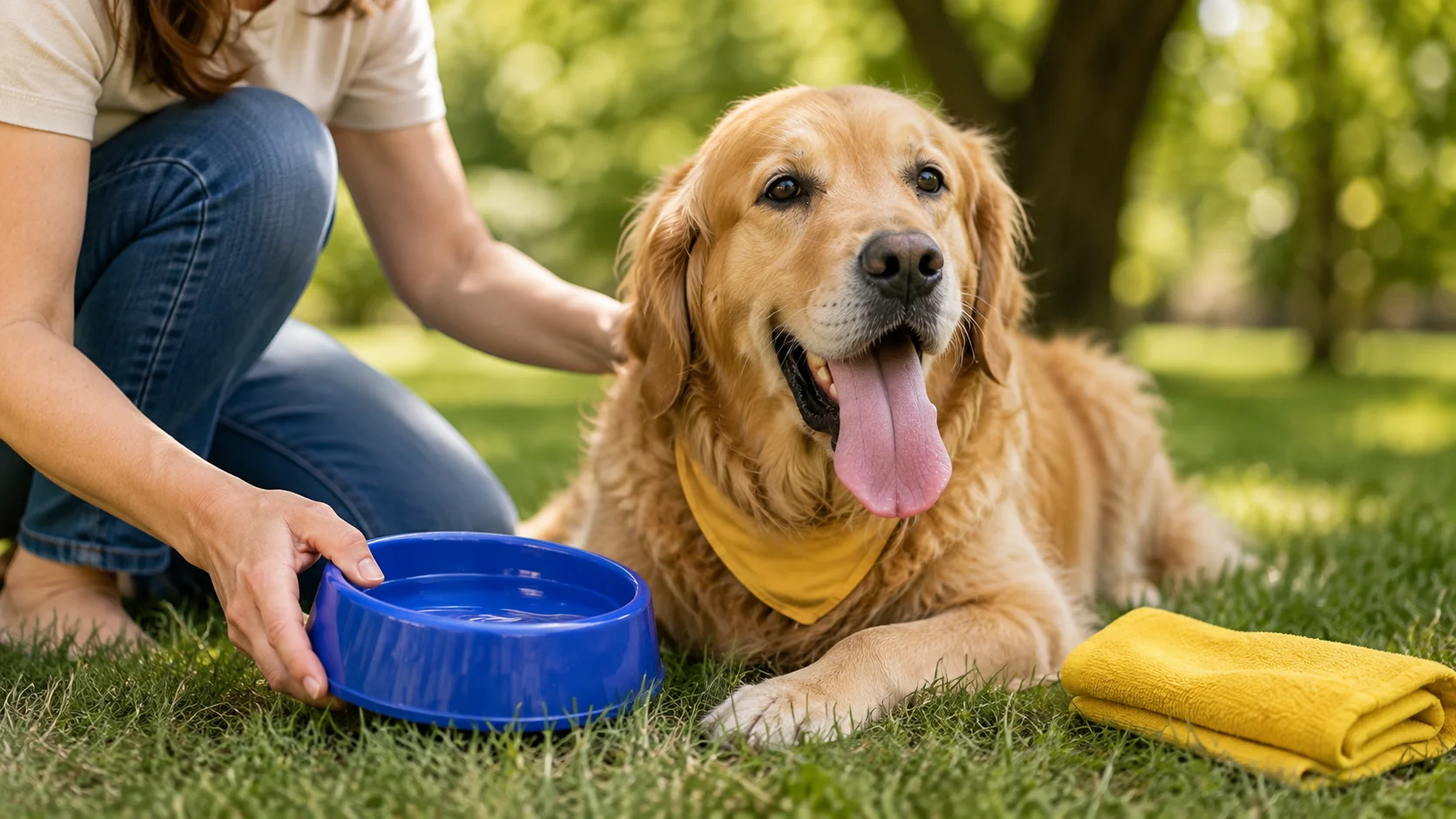
- Pour cool water over the belly, armpits, groin, and neck. Keep the water moving rather than draping a wet towel and leaving it, since soaked fabric warms up and holds heat in.
- Get air flowing across damp fur with a fan or the car's A/C.
- Once your dog perks up, offer small sips of water. Never force it.
- Call the nearest open veterinary clinic while you cool, and head in as soon as your dog can travel.
Stick to cool water rather than ice water, and never use rubbing alcohol.
One thing many owners miss: a dog that cools down and seems fine still needs a vet the same day. Heatstroke in dogs causes damage you cannot see, to the kidneys, the gut lining, and the blood's ability to clot, and those problems often surface hours after the tail starts wagging again.
Dogs that overheat first
Any dog can overheat, but some carry far more risk:
- Flat-faced breeds such as pugs, French bulldogs, English bulldogs, and Boston terriers, whose narrow airways limit panting
- Overweight dogs, since extra fat insulates and adds workload
- Thick-coated and dark-coated breeds
- Seniors, young puppies, and dogs with heart or breathing conditions
- Dogs new to exercise who get pushed too hard, too fast
If your dog fits one of these groups, plan summer around them. A wellness exam is a practical place to start, whether that means a weight plan or a conversation about safe exercise limits for a flat-faced breed.
Preventing heatstroke in dogs through a Toronto summer
- Walk early in the morning or after sunset, and shorten routes on humid days
- Press the back of your hand to the pavement for seven seconds; if it burns you, it burns paws
- Carry water on every outing and offer it often
- Check the Humidex before fetch, runs, or dog-park visits
- Never leave your dog in a parked car, even briefly, even with the windows cracked
- Give flat-faced dogs shorter, slower outings and switch to indoor play when it is muggy
Prevention costs nothing. Treating severe heatstroke in dogs can mean days of intensive care, and some dogs do not survive it. The math favours caution.
When to call TVS
If you are in Downtown Toronto or North York and your dog shows the danger signs above, call while you start cooling and come straight in. Our urgent care team sees same-day cases seven days a week, and our North York clinic stays open as late as 11 pm.
- TVS Animal Hospital North York: (416) 546-7493
- TVS Animal Hospital Parliament: (647) 347-3300
If your dog overheats outside our opening hours, go to the nearest open veterinary hospital rather than waiting for us. Speed matters more than loyalty. After any overheating episode, book a follow-up so we can run bloodwork and confirm the kidneys and clotting system came through unharmed.
Common questions about heatstroke in dogs
How hot is too hot for a dog walk?
No single number covers every dog, because humidity, pavement heat, coat, and breed all shift the line, and dogs can overheat from exertion even on mild days. Once the day feels muggy to you, assume it feels worse for your dog. Keep walks short, slow, and shaded, and skip hard exercise. Flat-faced dogs need an even lower threshold.
Can a dog get heatstroke indoors?
Yes. Apartments without air conditioning, sunrooms, and crates set near sunny windows all trap heat. During a heat wave, an upper-floor apartment can stay dangerous well into the night, so keep water down, close the blinds, and run a fan.
My dog recovered on his own. Do we still need an appointment?
Yes, the same day. The visible signs fade before the internal damage does. Kidney injury and clotting problems can build quietly for hours, and early bloodwork catches them while they are still treatable.
Is heatstroke the same as a fever?
No, and the difference changes what you should do. A fever is the body deliberately raising its own temperature to fight infection, so your vet treats the cause rather than the heat. Heatstroke is outside heat and exertion overwhelming the body, which is why immediate cooling saves lives.
Heatstroke in dogs is one of the few conditions where an owner's first ten minutes matter as much as anything a veterinary team does afterward. Learn the early signs, respect humid days, and cool first when something looks wrong. If you ever need us, call either clinic or reach us through our contact page and we will get your dog seen.