What Vaccines Your Puppy Needs in the First Year, and When
The question every new owner eventually asks is some version of this: why does my puppy need three rounds of the same shot? The answer is not that protection stacks up in layers. It is that her mother is still protecting her, and until that protection fades, most puppy vaccines cannot fully take hold.
Understanding that one mechanism turns the whole puppy vaccine schedule from a billing mystery into a plan you can see the logic of.
Why puppies need more than one dose
Nursing puppies absorb antibodies from their mother's first milk, and those maternal antibodies guard them through early life. The complication: while they circulate, they also neutralize vaccines, and they fade at an unpredictable point somewhere between six and sixteen weeks that varies puppy to puppy.
So veterinary guidelines solve the problem with repetition. A dose every three to four weeks means that whenever the maternal shield drops, a vaccine is right there to take over, and the dose given at sixteen weeks or later is the one that reliably lands. That is why stopping after the breeder's first two rounds is the classic mistake: a series that ends at twelve weeks has not actually finished.
The core puppy vaccines every dog gets
Three vaccines make up the core of the first year, recommended for every dog regardless of lifestyle:
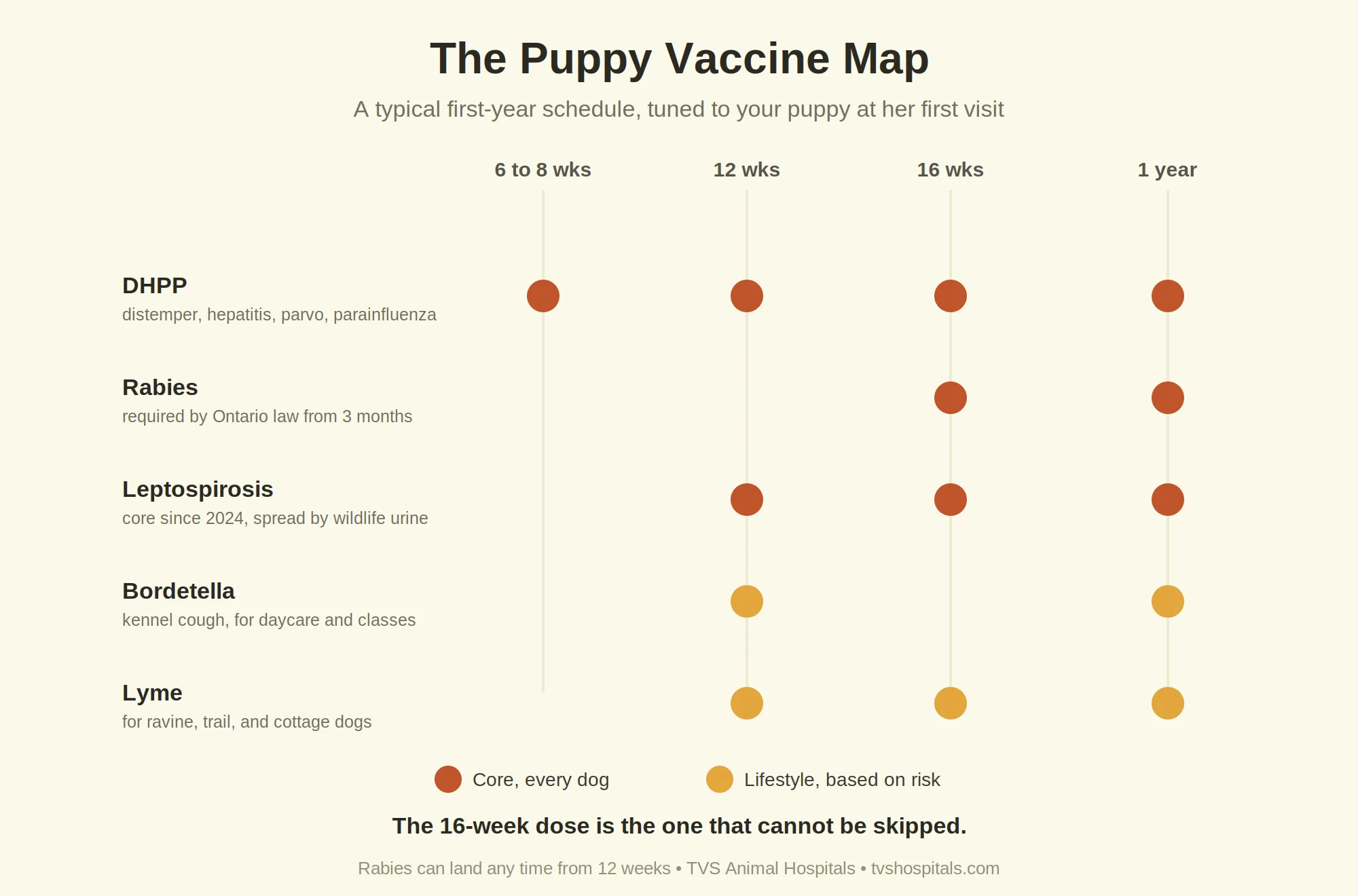
- DHPP, the combination shot covering distemper, hepatitis (adenovirus), parvovirus, and parainfluenza. It starts at six to eight weeks and repeats every three to four weeks until the final dose at sixteen weeks or later. Parvovirus alone justifies the discipline, since it remains a common and frequently fatal disease of under-vaccinated puppies.
- Rabies, a single dose given between twelve and sixteen weeks. This one is not a judgment call: Ontario law requires rabies vaccination for dogs from three months of age.
- Leptospirosis, which veterinary guidelines elevated to core status in 2024. The bacteria spread through wildlife urine and standing water, and a city full of raccoons, rats, and ravine puddles is exactly the environment the change was written for. Puppies get two doses, starting at twelve weeks, spaced two to four weeks apart.
The lifestyle vaccines worth a conversation
Two more puppy vaccines depend on how your dog will actually live:
- Bordetella, against kennel cough, earns its place the moment daycare, boarding, grooming, or puppy classes enter the picture, and most of those facilities require proof of it
- Lyme, for dogs who will hike, cottage, or spend real time along ravines and trails, given as two doses two to four weeks apart. Our tick season guide covers why that exposure now includes much of Toronto.
Neither is automatic. At your first visit we ask about daycare plans, cottage summers, and neighbourhood routines, then build the vaccine plan around the life your puppy will lead rather than a standard printout.
What to expect after each visit
Most puppies sleep a little more that evening, and some are tender at the injection site for a day. That is an immune system doing its job. What warrants a call is different: facial swelling, hives, vomiting, or collapse in the hours after a visit, which our urgent care team treats as a come-in-now situation.
Perspective helps here. Reviewing the most discussed vaccine, leptospirosis, AAHA counts fewer than 53 adverse events per 10,000 doses, most of them minor, against diseases that are routinely fatal. The math is not close.
After sixteen weeks
The one-year boosters consolidate everything the puppy vaccine series built. From there, the combination vaccine typically moves to a three-year cycle, rabies follows a one-to-three-year cycle under its certificate, and lifestyle vaccines repeat annually while the risk lasts.
Keep the records findable. Daycares, boarders, groomers, trainers, and the travel paperwork for any cross-border trip will all ask for them, and at TVS Animal Hospitals your puppy's full history stays on file at both clinics, retrievable whenever a form demands it.
Common questions about puppy vaccines
The breeder gave her two rounds. Is she done?
Not yet. What matters is not how many doses she has had but when the last one happened. Until a dose lands at sixteen weeks or later, maternal antibodies may have blocked the earlier ones, so bring the breeder's record to your first visit and we will map the remaining schedule.
When is she fully protected?
About one to two weeks after that final sixteen-week round. Until then, follow the socialization approach from our first-year puppy checklist: controlled introductions yes, dog parks and unknown dogs not yet.
I adopted a five-month-old with no vaccine history. Does she need the whole puppy series?
No, and this surprises people. Past sixteen weeks, maternal antibodies are gone, so an unvaccinated older puppy typically needs just two doses of the combination vaccine, two to four weeks apart, plus rabies and the lifestyle discussion.
Why do prices vary between rounds?
Because the visits are not identical. Some rounds carry one injection, others carry two or three, and each includes an exam, since a vaccine should only ever go into a healthy puppy. We quote each visit upfront so nothing surprises you.
The first-year puppy vaccine schedule asks for four visits and a bit of calendar discipline, and in exchange it removes parvovirus, distemper, and rabies from the list of things that can happen to your dog. Call TVS Animal Hospital North York: (416) 546-7493 or TVS Animal Hospital Parliament: (647) 347-3300, or book her series through our contact page, and we will keep the timing honest.